

Encouraging results in 4th Labour Rights Index suggest global progress toward access to decent work
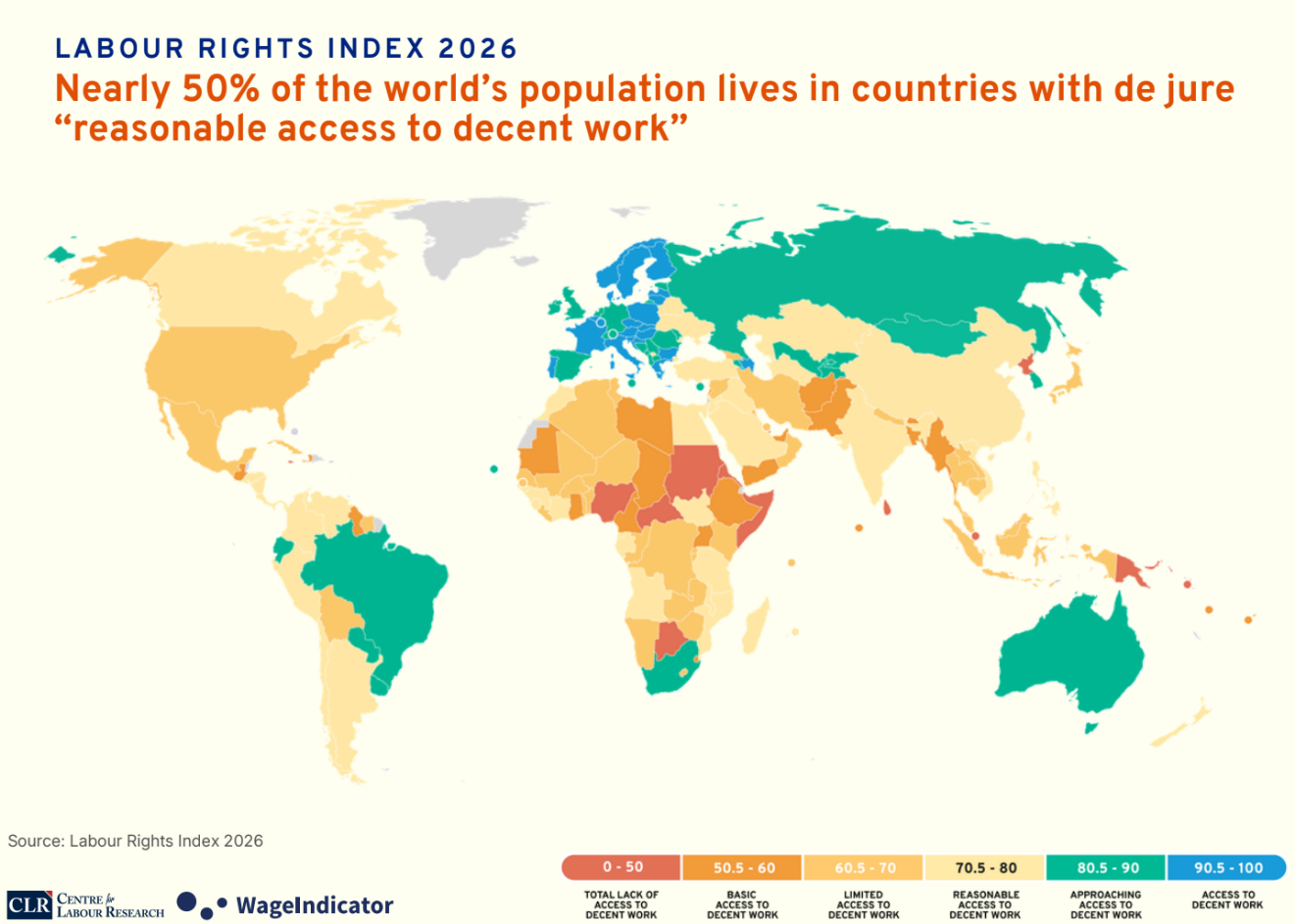
Labour Rights Index 2026 map
Labour legislation has improved in most countries in the past two years
There's a march toward the top rather than a race to the bottom. Legislation in most countries is improving, which suggests the legislature’s intent”
AMSTERDAM, NOORD HOLLAND, NETHERLANDS, October 6, 2026 /EINPresswire.com/ -- WageIndicator Foundation and the Centre for Labour Research publish today the 4th Labour Rights Index, ahead of the World Day for Decent Work, observed yearly on October 7.— Iftikhar Ahmad, Lead Researcher for the Labour Rights Index.
The Labour Rights Index looks at every aspect of the working lifespan of a worker and identifies the presence of labour rights, or their absence, in national legal systems worldwide. It has 10 indicators and 48 components or evaluation criteria, grounded in ILO standards. The scoring is based on an exhaustive analysis of thousands of pages of labour legislation.
The fourth iteration of this de jure index builds on the previous versions released in 2020, 2022 and 2024, providing objective legal data on labour laws in 168 countries (23 more than in 2024). It is the world’s most comprehensive one yet in terms of scope.
In this edition, findings show that nearly 50% of the world’s population lives in countries with de jure “reasonable access to work” (42 countries). Only 3.55% of the world’s population has “access to decent work,” the highest score possible (21 European countries). In 2026, 13 countries, or 4.75% of the population, still lack access to decent work.
Significant labour reforms:
In the past two years (between 1 January 2024 and 1 January 2026), WageIndicator recorded 134 legal changes across 70 countries. Favourable score-changing reforms were recorded in Mali, India, Lebanon and 16 other countries.
Mali’s 2024 Penal Code introduced an express prohibition of sexual harassment. India brought four labour codes into force in November 2025, resulting in several improvements: employers must provide written appointment letters; women may work in all establishments and occupations, including at night with their consent and subject to safeguards; and pregnant and nursing workers receive stronger health protection. Lebanon introduced a statutory framework for part-time, remote, seasonal and compressed working arrangements, including a route for employees returning from maternity leave to move temporarily to part-time work with their employer’s agreement.
Twenty changes caused component scores to fall to 0 (the lowest score). Eleven resulted from countries not revising their minimum wages within the scoring window. The other nine resulted from legislative changes in eight countries: Argentina, Egypt, Ethiopia, Guinea, India, Lesotho, Madagascar and Tunisia. These score reductions should be interpreted component by component. Some reflected a clear weakening of protection, while others resulted from the revised law no longer meeting a specific Labour Rights Index threshold, even where other aspects of the law became more protective.
A new methodology for a new labour reality:
Besides the addition of 23 new countries, the 2026 index methodology expanded its total components (“indicators”) from 46 to 48, reflecting the reality of labour demands. For example, the new methodology features revised indicators around probationary periods, forced labour remediation, platform economy jobs, and maternity benefits. The index also has three new questions covering the topics of childcare services, the right to leave work in case of imminent danger, and social dialogue.
Transparent labour market data accessible to all:
WageIndicator created the Labour Rights Index to make labour law information accessible, comparable, and actionable. As a rigorous international qualification, it analyses and scores labour market regulations affecting more than 95% of the global labour force of 3.5 billion people.
The index can be a useful tool for companies too, as it identifies Human Rights Due Diligence (HRDD) risks in the legal framework. For each indicator, it maps the risk that a legal gap signals to the cross-cutting frameworks for which that indicator is most relevant: the UN Guiding Principles and the ILO Multinational Enterprises (MNE) Declaration; the OECD Guidelines; the EU Corporate Sustainability Due Diligence Directive (CSDDD), and the EU Forced Labour Regulation.
This year, the index has a more robust methodology, now more tightly linked to United Nations Human Rights Treaties, in addition to the International Labour Organisation conventions. For the first time, the index also draws upon the supervisory reports of ILO’s Committee of Experts on the Application of Conventions and Recommendations (CEACR) and the Committee on Freedom of Association’s Digest of Decisions.
Blanca Civit
WageIndicator Foundation
email us here
Visit us on social media:
LinkedIn
Labor Rights Index 2026 | Comparing Labour Laws Across 168 Countries
Legal Disclaimer:
EIN Presswire provides this news content "as is" without warranty of any kind. We do not accept any responsibility or liability for the accuracy, content, images, videos, licenses, completeness, legality, or reliability of the information contained in this article. If you have any complaints or copyright issues related to this article, kindly contact the author above.
